
What Does a Flight Nurse Actually Do? A 24-Hour Shift With a PHI Air Medical Crew
Medically reviewed by James “Trae” Bane, BSN, CFRN, CMTE, Director of Clinical Standards, PHI Air Medical. Last reviewed November 6, 2026.
What does a flight nurse actually do? Most people picture the helicopter and stop there. The aircraft is one part of the job. A flight nurse is a critical care clinician who delivers intensive-care-level treatment in a space the size of a closet, at altitude, with one partner, often for a patient they met four minutes ago.
This guide follows a PHI Air Medical crew through a typical 24-hour shift. It explains who is on the crew, what they check before anyone calls, what happens when the pager goes off, and what the rest of the day looks like when it does not. We also cover what it takes to become a flight nurse or flight paramedic, and how a PHI Cares Membership fits, with $0 out-of-pocket responsibility for medically necessary flights by PHI Air Medical or a cooperative partner.
Who Is on a PHI Air Medical Crew
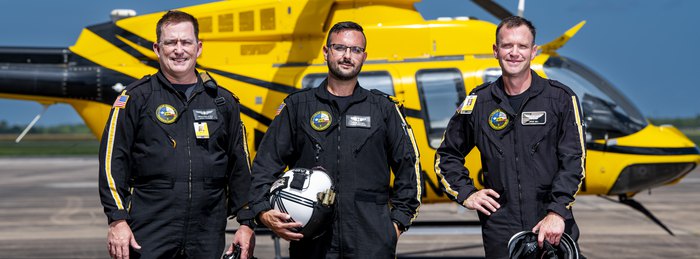
A standard PHI Air Medical crew is three people: a pilot, a flight nurse, and a flight paramedic.¹ The two clinicians work as a pair, and the pairing is deliberate. The nurse brings hospital critical care experience, typically from an intensive care unit or emergency department. The paramedic brings field experience from ground EMS, scene management, and airway and trauma skills built on the street. Between them they cover the full range of what a patient might need.
Behind the crew is an online medical control physician, available by radio or phone for orders that go beyond standing protocols.¹ Behind the physician is a communications center that handles dispatch, tracks the aircraft, and coordinates with hospitals and ground EMS. PHI Air Medical operates 71 membership bases across 14 states, and each one runs this way.¹
The crew that flies is only part of the team. Every PHI Air Medical base has aircraft maintenance on site, and the mission does not happen without them. The maintenance team inspects and services the aircraft and signs it off as airworthy before it carries anyone, and they hold the authority to take it out of service. The clinical crew depends on that judgment every time they lift.
Our earlier post on the certifications behind PHI Air Medical flight nurses and paramedics covers the credentials in detail. This one is about the shift.
0700: Shift Change and the Walk-Around
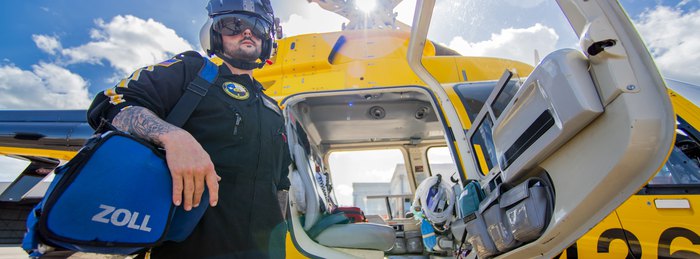
Shifts commonly run 12 or 24 hours, and the day starts with a handoff from the outgoing crew. That handoff carries real weight. Anything that happened overnight gets passed along: a hard call, a piece of equipment that acted up, a hospital that changed a procedure. It is also where the outgoing crew accounts for what was used and what was replaced, because the crew coming on may be in the air before they have finished looking at anything.
Then the checks. At the start of every shift the clinicians work through the aircraft and equipment. These checks are not a gate the crew passes through before becoming available. A call can come at any moment, including in the middle of them, and the crew goes. That is precisely why the handoff and a properly restocked aircraft matter as much as they do: if the pager sounds ten minutes into the shift, what protects the patient is that the aircraft was left ready by the crew before. What the clinicians are confirming is:
- The monitor and ventilator. Power, batteries, alarms, circuit. A ventilator that fails at altitude is a different problem than one that fails in an ICU.
- The medication bag. Counted, sealed, in date. Controlled substances are logged and signed.
- Blood products. PHI Air Medical carries blood on many aircraft, and it has to be stored, tracked, and rotated correctly. Our post on the PHI Cares blood-on-board program explains why.
- Airway equipment. Laryngoscope, tubes in every size, suction, backup devices. All checked, all in reach.
- The cabin itself. Stretcher locks, oxygen supply, lighting, restraints, communication headsets.
While the clinicians work the cabin, the pilot works the aircraft, the weather, and the fuel. A weather briefing happens every shift and again before every flight. PHI Air Medical will decline a flight when the weather is outside limits, and the crew is trained to treat that as the right answer rather than a failure.
0930: The Pager Goes Off
Calls come in two types, and the shift can hold either.
A scene call
A 911 dispatcher, or a ground EMS crew already on scene, requests the helicopter for a patient at the site of an injury: a highway crash, a farm accident, a fall. The crew is airborne within minutes. On the way, the pilot handles the flight and the clinicians get what information exists: the mechanism, the patient count, the landing zone. Our post on how medical helicopter landing zones work explains what the ground crew sets up.
On scene, the flight nurse and paramedic work alongside ground EMS. The handoff is fast and structured. What happened, what has been done, what the vital signs are. Then the crew takes over: airway, breathing, circulation, bleeding control, immobilization, pain management, and the decision about which hospital the patient needs, made with medical control and dispatch.
An interfacility transfer
The other kind of call starts at a hospital. A community emergency department has a patient who needs care it cannot provide: a heart attack that needs a cath lab, a stroke that needs a neurointerventional team, a burn that needs a burn center, a premature infant, a septic patient who needs an ICU. The sending physician requests transport. The crew flies in, receives a full report, takes over the drips and the ventilator, and flies the patient out.
Interfacility transfers are often the more clinically complex work. The patient may be on several medication infusions, a ventilator, and continuous monitoring, all of which the flight nurse manages in the air. The crew also radios ahead so the receiving team is ready at the door.
In the Air: Critical Care in a Small Space
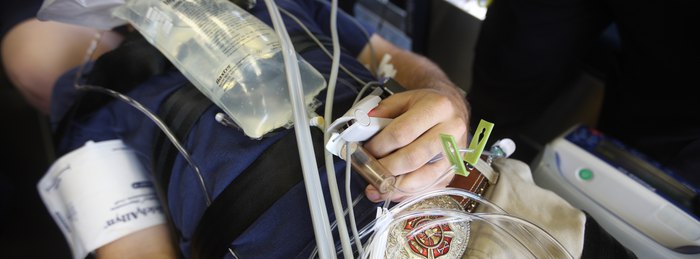
Flight nursing is intensive care with constraints an ICU nurse never faces. The cabin is loud enough that assessment relies on the monitor and on touch more than on hearing. Space is tight enough that everything has a place, because reaching for something that is not there is not an option. Altitude changes how gases behave, which matters for a patient with a chest injury or a bowel obstruction. Vibration and temperature affect equipment and patients alike.
The flight nurse and paramedic split the work and cross-check each other. One manages the airway and ventilator, the other manages circulation and medications, and they switch as the patient’s needs change. Medical control is a radio call away for orders outside protocol. The pilot flies the aircraft and is deliberately kept out of the medical decision, so that the decision to fly or not fly is never influenced by how sick the patient is.
On landing, the handoff to the hospital team is as structured as the one on scene: what happened, what was done in the air, what the trends were, what the receiving team should watch for. Then the documentation, which is thorough because it becomes part of the patient’s medical record.
1400: Back at Base, and the Work That Is Not Flying
After a call, the aircraft is cleaned and decontaminated, supplies are restocked, controlled substances are reconciled, and the crew is back in service. The restocking is done completely rather than partially, for the same reason the handoff matters: the next call can come before anything left undone gets finished. A crew that returns to base at 1400 may be airborne again at 1415.
On a 24-hour shift, most of the hours are not spent flying. They are spent on the work that keeps the crew ready:
- Training and continuing education. Skills that are rarely used have to be practiced. Surgical airways, chest decompression, neonatal resuscitation, and obstetric emergencies are drilled because the crew may see one a year.
- Case review. Calls are reviewed with medical control and peers. What went well, what could have gone better.
- Community work. Landing zone training for volunteer fire departments, station visits, school events. The crew is often the face of the program in a small town.
- Rest. A 24-hour shift includes protected rest, because a crew that has been awake for 20 hours should not be making critical care decisions at altitude.
And then the pager goes off again, at 2 in the afternoon or 2 in the morning, and the day starts over.
What It Takes to Become a Flight Nurse or Flight Paramedic
The path is long, and that is by design.
- Flight nurse. A registered nurse license and, at most programs, several years of critical care experience in an ICU or emergency department. Certifications commonly include advanced cardiac and pediatric life support, a trauma nursing course, and the Certified Flight Registered Nurse credential from the Board of Certification for Emergency Nursing, which many programs require within a set period after hire.²
- Flight paramedic. A paramedic license and several years of experience with a high-volume ground EMS service. The Certified Flight Paramedic credential is administered by the International Board of Specialty Certification.³
- Both. Flight physiology and aircraft safety training, survival training, and ongoing competency in skills that go beyond the hospital or ground scope of practice.
The Air and Surface Transport Nurses Association publishes standards and resources for nurses considering the specialty.⁴ Our post from National Nurses Week on PHI Air Medical flight nurses introduces some of the people who do this work, and our overview of the PHI Air Medical fleet covers the aircraft they fly in.
How PHI Cares Membership Supports Your Household
Emergency air transport may result in significant out-of-pocket responsibility depending on the situation and your insurance plan. Financial responsibility can vary. A membership program lets families settle that question in advance rather than during a hospitalization.
PHI Cares helps households prepare for unexpected emergency transport situations. Members have $0 out-of-pocket responsibility for medically necessary flights by PHI Air Medical or a cooperative partner. PHI Cares works with your insurance provider and accepts the insurance payment as payment-in-full, according to membership terms.
One household membership includes your spouse, dependents living at the same address, and up to 3 additional people at the same address. Coverage begins 5 days after enrollment. Review options on our memberships page, and confirm your area is served using our coverage map.
Frequently Asked Questions About Flight Nurses
What does a flight nurse do?
A flight nurse delivers critical care to patients during air medical transport, both at the scene of an injury and on transfers between hospitals. That includes airway management, ventilator care, medication infusions, blood administration, and continuous monitoring, in partnership with a flight paramedic and supported by an online medical control physician.
What are the requirements to become a flight nurse?
A registered nurse license, typically several years of ICU or emergency department experience, advanced life support certifications, and the Certified Flight Registered Nurse credential from the Board of Certification for Emergency Nursing, which many programs require within a set period after hire.²
What is the difference between a flight nurse and a flight paramedic?
Both are critical care clinicians on the same crew. The flight nurse typically comes from hospital critical care and the flight paramedic from ground EMS. They share the work in the air and cross-check each other. Flight paramedics hold the Certified Flight Paramedic credential from the International Board of Specialty Certification.³
Who else works at an air medical base?
Alongside the flight crew, every base has aircraft maintenance on site. The maintenance team inspects, services and signs off the aircraft as airworthy, and has the authority to take it out of service. A base is also supported by an online medical control physician and a communications center that handles dispatch and tracks the aircraft.
How long is a flight nurse shift?
Shifts commonly run 12 or 24 hours. A 24-hour shift includes equipment checks, training, community work, and protected rest, with calls at any hour.
Who decides whether a helicopter is sent?
911 dispatchers, ground EMS on scene, and sending physicians request air medical transport. The pilot makes the decision to fly based on weather and safety, separately from the patient’s condition. Families do not need to arrange any part of it.
Who can enroll in PHI Cares?
Most households in a PHI Cares service area can enroll, and one plan includes your spouse, dependents at your address, and up to 3 additional people at the same address. Federal law does not permit Medicaid participants to enroll in air medical membership programs. See the PHI Cares FAQ page for details and current eligibility information.
The next time a yellow helicopter passes overhead, picture the two people in the back, and the shift they are in the middle of. That is who shows up.
Membership in the PHI Cares Program is not an insurance product. PHI Cares does not cover and will not pay or reimburse you for services performed by any other air medical transport services provider or any ground ambulance services provider.
Sources
¹ PHI Air Medical. Official website. https://phiairmedical.com/
² Board of Certification for Emergency Nursing. Certified Flight Registered Nurse (CFRN). https://bcen.org/cfrn/
³ International Board of Specialty Certification. Certified Flight Paramedic (FP-C). https://www.ibscertifications.org/
⁴ Air and Surface Transport Nurses Association. Official website. https://www.astna.org/