
Blood on Board: How Blood Products in the Air Help Save Lives
Winter can make emergencies harder. Roads get slick, visibility drops, and distance feels longer. The hopeful part is that emergency care is built around preparation and speed, especially in the first stretch of time when a patient’s condition can change fast.
You will often hear the phrase the golden hour, a practical reminder that earlier stabilization and faster access to definitive care can matter. It is not a guaranteed “60-minute rule,” but it helps explain why trauma systems and transport teams work to reduce delays wherever possible.1
January is National Blood Donor Month, and it is one of the clearest ways the public can support that readiness. Donors act before the emergency happens, so blood products are available when minutes matter.2 3
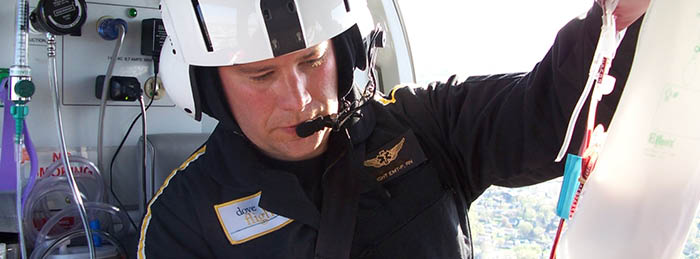
A PHI Air Medical clinician prepares blood products during critical care transport.
At a glance
- Blood on board means an aircraft may carry blood products so care can start during transport, when clinically appropriate.6
- Blood products can include red blood cells, plasma, platelets, and whole blood, depending on the program and patient needs.4 5
- PHI Air Medical highlights Blood Transport as part of its capabilities and focuses on delivering “the right product to the right patient at the right time.”7
If you want to be prepared for the unexpected, PHI Cares Membership is a simple step you can take before an emergency.
January is National Blood Donor Month for a reason
National Blood Donor Month has been recognized for decades. President Richard Nixon issued Proclamation 3952, designating January 1970 as National Blood Donor Month and calling for public support of voluntary blood donation.3
January is also a realistic choice. AABB notes that winter months are often a period of reduced donations due to illness, holiday schedules, and inclement weather, along with a higher risk of shortages.2
Hospitals also cannot “stock up” indefinitely. Blood and blood components have limited shelf lives, and it takes time after donation for screening and testing before products are ready for use.4 That is why this month matters. It is a reminder that readiness is built in advance.
If there is one message that fits this month, it’s this: you cannot donate after the emergency. You donate before it.

A blood donation in progress helps keep blood products available for emergencies.
The golden hour and why time matters
The golden hour is a useful framework for urgency. It supports a basic truth that does not change: when a patient is critically ill or severely injured, delays raise risk.1
For severe bleeding, that urgency is even more direct. Blood loss is time-sensitive. Early decisions can shape what happens next.
What “blood products” means in plain English
When people hear blood on board, they often picture a single product. In reality, clinicians use different blood products depending on what the patient needs.
- Red blood cells help carry oxygen.
- Plasma is the liquid part of blood. It carries proteins and plays a role in clotting.
- Platelets help form clots.
- Whole blood includes cells and platelets suspended in plasma. The American Red Cross explains that whole blood can be used as whole blood or separated into components depending on need.5
The big idea is not that one product is “best.” It’s that the right product can be started at the right time, based on what the patient’s condition calls for.
Why medical helicopters carry blood products
Some patients cannot wait until they reach the emergency department to start replacing what they are losing. When bleeding and shock are the problem, time and distance are not just logistics. They are part of the clinical challenge.
That is why some helicopter EMS programs carry blood products. It gives care teams an option to begin time-sensitive treatment during transport, not only after arrival.6 In the context of the golden hour, it’s another way to start critical care sooner while the patient is moving toward definitive treatment.
How PHI Air Medical uses blood on board
PHI Air Medical has long focused on bringing critical care capability to patients during transport. Blood on board is part of that readiness, supporting rapid stabilization when minutes matter.
PHI Air Medical lists Blood Transport as part of its capabilities. On its website, PHI Air Medical states it was “the first organization of our size to adopt blood products on board our aircraft” as best practice, and it highlights the goal of delivering “the right product to the right patient at the right time.”7
PHI Air Medical also announced that, through a partnership with the American Red Cross, it will carry warmed whole blood on all PHI aircraft in Arizona and New Mexico.8 This is in addition to other PHI Air Medical bases across the country that also carry blood products on board.
Alongside clinical readiness, PHI Cares Membership helps households plan for the financial side of a medically necessary PHI Air Medical flight.
Why “warmed” matters
Temperature management is a real challenge in trauma and massive bleeding. Blood warming devices are commonly used during massive transfusion situations to help prevent complications associated with hypothermia.9 In plain language, keeping resuscitation fluids and blood products warm supports better temperature management during critical care.

An air medical clinician monitors IV tubing as part of time-sensitive critical care transport.
When blood on board can matter most
Blood products on aircraft are not for routine calls. They matter most when the patient’s condition is moving in the wrong direction and early stabilization is critical.
Severe trauma with suspected major bleeding
In major trauma, rapid blood loss can lead to shock. Early stabilization during transport can support the path to surgery or other definitive treatment.
Critical medical bleeding
Life-threatening bleeding is not limited to trauma. Certain medical emergencies can also involve severe blood loss, and the priority remains the same: stabilize quickly and get the patient to the right level of care.
Long distances and rural access
Even the best hospital cannot help if the patient cannot reach it in time. For many communities, air medical transport closes the distance gap and brings advanced care into the transport window.
Blood donation and blood safety: what makes blood on board possible
Blood transfusion is a medical therapy. It saves lives, and it carries risk, which is exactly why donor screening, testing, and oversight matter.
The CDC notes that the U.S. blood supply is safer than it has ever been.10 The FDA also describes how donated blood is screened and tested before it is used for transfusion.4
This is the system donors support: a steady, tested supply that can be used in hospitals and, in some systems, during critical care transport.
What donors should know and do right now
If you are eligible to donate, do not overthink it. Pick a date and commit. National Blood Donor Month is a reminder that consistency beats good intentions.
- Choose a donation site that is convenient, then schedule it.
- Hydrate and eat beforehand, then bring your ID.
- Keep the appointment once it’s on your calendar.
Donate this month. You may be the reason blood products are available when minutes matter.
Donating supports readiness in your community, and PHI Cares Membership supports readiness at home.
Where to donate blood
If you’re eligible to donate, schedule an appointment with a reputable blood collection organization near you:
- AABB: www.WhereToDonateBlood.org | +1.301.907.6977
- America’s Blood Centers: www.AmericasBlood.org | +1.202.393.5725
- American Red Cross: www.RedCrossBlood.org | +1.800.RED CROSS (+1.800.733.2767)
Frequently asked questions
Do medical helicopters really carry blood?
Some do. Many helicopter EMS programs carry blood products so treatment can start during transport when clinically appropriate.6
Does “blood on board” mean it’s always whole blood?
No. “Blood on board” can refer to a range of blood products, including red blood cells, plasma, platelets, and in some programs, whole blood.4 5
Why would whole blood be warmed?
Warming supports temperature management during massive transfusion situations and helps reduce complications associated with hypothermia.9
Does donating blood actually affect emergency availability?
Yes. Winter can reduce donations, and blood products require screening and testing before they are ready for transfusion. A steady donor supply supports availability when emergencies happen.2 4
Is the golden hour a real thing?
It is a widely used trauma care concept that emphasizes urgency, but it is not a guaranteed one-hour rule. It’s best understood as a reminder to reduce delays and deliver the right care quickly.1
Where PHI Cares Membership fits in
In an emergency, the priority is getting the right care fast. If a medically necessary PHI Air Medical transport happens, PHI Cares Membership can help lower what you may owe for PHI transports, based on membership terms. Learn more about PHI Cares Membership at https://phicares.com/.
Sources
- PubMed: “The golden hour: scientific fact or medical ‘urban legend’?” https://pubmed.ncbi.nlm.nih.gov/11435197/
- AABB: National Blood Donor Month https://www.aabb.org/for-donors-patients/national-blood-donor-month
- UCSB American Presidency Project: Proclamation 3952 (National Blood Donor Month) https://www.presidency.ucsb.edu/documents/proclamation-3952-national-blood-donor-month
- FDA: Have You Given Blood Lately? https://www.fda.gov/consumers/consumer-updates/have-you-given-blood-lately
- American Red Cross: Blood Components https://www.redcrossblood.org/donate-blood/how-to-donate/types-of-blood-donations/blood-components.html
- Maryland State Police News Release: “Blood on Board: Equipping Maryland’s Air Medical Response With Whole Blood To Save Lives” https://news.maryland.gov/msp/2023/08/21/blood-on-board-equipping-marylands-air-medical-response-with-whole-blood-to-save-lives/
- PHI Air Medical: Blood Transport statement (Capabilities) https://www.phiairmedical.com/phi-air-medical/
- PHI Air Medical: In The News (links to the warmed whole blood announcement) https://www.phiairmedical.com/in-the-news/
- AABB sample PDF: Guide to the Use of Blood Warming Devices https://marketplace.aabb.org/PRODUCTFILES/16971885/233015_sam.pdf
- CDC: Blood Safety Basics https://www.cdc.gov/blood-safety/about/index.html