Snow Sports Safety: Skiing, Snowboarding, and Air Medical Emergencies
Snow Sports Safety: Skiing, Snowboarding, and Air Medical Emergencies
Snow sports safety is essential for skiing and snowboarding in winter mountain terrain. Most days are routine, but serious injuries can happen quickly.
Winter mountain sports are fast, physical, and unpredictable. The days that are not usually involve a collision, a hard fall, changing visibility, fatigue, or an injury in terrain that is difficult to reach by road.
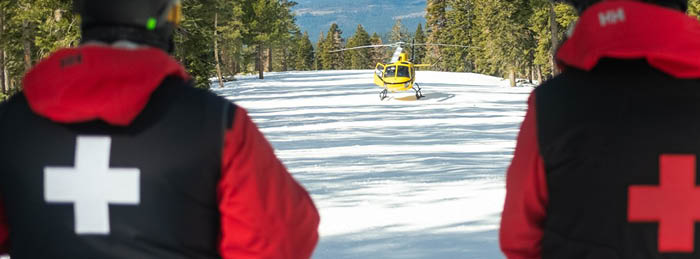
Most on-mountain injuries are handled by ski patrol and local emergency services. When an injury is severe, time-sensitive, or remote, an air medical helicopter may be requested as part of the emergency response. A helicopter response is always situational and depends on medical need, dispatch protocols, weather, and aircraft availability.
This guide covers:
- Snow sports safety steps that lower risk
- The NSAA Responsibility Code explained in plain language
- What to do in the first minutes after a serious crash
- Landing zone training and winter readiness near ski areas
- How PHI Cares membership supports households if an air medical flight happens
The NSAA Responsibility Code, explained
The National Ski Areas Association (NSAA) publishes the Responsibility Code. It is a short list of widely used on-slope safety rules. Think of it as the rules of the road for skis and boards.
NSAA lists seven responsibilities:
- Always stay in control so you can stop or avoid people or objects.
- People downhill have the right-of-way. You must avoid them.
- Stop only where you are visible from above and do not restrict traffic.
- Look uphill and avoid others before starting downhill or entering a trail.
- Prevent runaway equipment.
- Read and obey all signs, warnings, and hazard markings.
- Keep off closed trails and out of closed areas.
These rules reduce collisions and help keep ski patrol responses focused on unavoidable emergencies rather than preventable ones.
Snow sports safety that protects you
Helmet and head safety
Wear a helmet on every run. No helmet prevents every concussion, but helmets can reduce the risk of serious head injury. Fit matters. The helmet should sit level, feel snug, and stay stable when you move your head.
Vision and flat light
Flat light hides ruts, bumps, and drop-offs. If you cannot read the snow clearly, slow down. If you still cannot see, take a break. Good goggles and the right lens for the day help you stay in control.
Wrist, hand, and shoulder protection
Snowboarding falls often involve outstretched hands. Wrist guards are worth considering, especially for beginners. Gloves that stay warm and dry also help with grip and reaction time.
Knees and lower body safety
Many knee injuries happen late in the day when fatigue shows up. Lower your risk with simple habits:
- Warm up on easier runs.
- Save jumps, parks, and steep lines for when you are fresh.
- Take breaks for food and water.
- If your legs are shaking, you are done for the day.
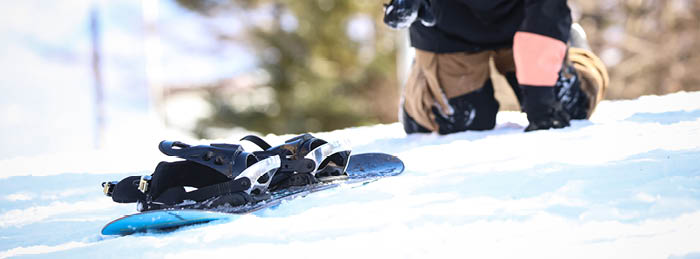 Snowboarder reaching for a board after a fall on a snowy mountain slope.
Speed control to prevent collisions
Collisions happen most often in crowded, merged, or narrow areas like cat tracks, lift lines, and runouts. The faster rider has the responsibility to avoid the slower rider. Slow down in traffic and give people space.
Stop where you are visible
If you stop, pull off to the side where you can be seen from above. Do not stop below a rollover or around a blind corner. If you need to regroup, pick a wide, visible shoulder.
Trees and deep snow: use a buddy plan
Deep snow and trees are where small mistakes can turn serious quickly. If you are riding trees or powder:
- Ride with a partner and keep each other in sight.
- Agree on regroup points before you drop in.
- Carry a whistle.
Out-of-bounds and backcountry: treat it as a different sport
Leaving controlled terrain changes everything. It takes training, rescue gear, and disciplined decision-making. If you do not have training and the right equipment, stay in-bounds.
What to do in the first 5 minutes after a serious crash
- In-bounds: call ski patrol.
- Remote or out-of-bounds: call 911.
- Share your location: trail name, lift name, last marker, GPS pin if possible.
- If a head, neck, or back injury is possible, do not move the person unless there is immediate danger.
- Prevent heat loss: add layers, block wind, and insulate them from snow.
Air medical transport may be requested when injuries are time-sensitive or when terrain and distance slow ground access.
When air medical transport may be requested
A helicopter may be requested when:
- The injury is severe and time matters
- Terrain blocks quick ground access
- Distance to the right hospital is significant
- Weather and road conditions slow ground transport
A nearby base can make an air medical response possible, but it is never a promise. Weather, visibility, availability, and dispatch decisions determine what happens in real time.
Landing zone training and winter readiness near ski areas
Landing zone safety matters any time a helicopter response is part of a regional emergency plan. Safe operations require coordination between air crews and the responders on the ground.
PHI Air Medical shares ongoing education and outreach for first responders and community groups, including programs that support safer operations in the field. Learn more about PHI Air Medical and its national footprint at
PHI Air Medical and explore
PHI Air Medical locations.
In winter recreation areas, coordination often includes ski patrol and local EMS. Training helps teams practice:
- How to choose and manage a safe landing area
- Communication and handoff roles
- Keeping the scene secure and free of hazards
- Managing blowing snow, loose gear, and crowded environments
If you are curious about the kinds of education and outreach programs PHI Air Medical supports, see
Education and Outreach.
This preparation supports safer operations if a helicopter is requested during a winter emergency.
PHI Cares membership and winter travel
PHI Cares is household protection for air medical emergencies. If a household member is flown in a medically necessary air medical transport and the flight is provided by PHI Air Medical or a cooperative service partner, the member has no out-of-pocket costs for the flight, based on program terms.
This matters for snow sports because ski trips often place you far from the hospital you would want in a severe injury. Even in-bounds, getting from the slope to advanced care can take time. PHI Cares is a way for households to plan ahead financially if an air medical flight becomes part of the emergency response.
Additional PHI Cares membership benefits
Depending on the program’s current features and terms, PHI Cares membership is built around:
- Household coverage for eligible air medical transports
- Financial peace of mind during travel and outdoor activities
- A clear process for members if a flight occurs
If you want to learn more or join, start here:
PHI Cares Memberships
and
How PHI Cares Works.
For destination planning, the coverage map is the best way to confirm service areas and cooperative partners for where you are traveling:
PHI Cares Coverage Map.
Related reading
- Understanding the PHI Air Medical Coverage Map
- How to Protect Yourself from Helicopter Air Ambulance Bills
- Air Medical Membership Guide: Cost and Coverage Basics
FAQ
What is the NSAA Responsibility Code?
It is a seven-point set of slope safety rules used across U.S. ski areas. It covers staying in control, yielding to downhill traffic, stopping where visible, looking uphill before merging, preventing runaway equipment, obeying signs, and staying out of closed areas.
Does a helicopter respond to every serious ski injury?
No. A helicopter response depends on medical need, dispatch decisions, weather, and aircraft availability.
What is landing zone training?
Landing zone training teaches responders how to choose and manage a safe helicopter landing area, communicate with the aircraft, and keep the scene safe for crews and bystanders.
How does PHI Cares membership help during ski travel?
If a household member needs a medically necessary air medical flight and the transport is provided by PHI Air Medical or a cooperative partner, the member has no out-of-pocket costs for the flight.